'/%3e%3cpath%20id='Vector_2'%20fill-rule='evenodd'%20clip-rule='evenodd'%20d='M41.7365%206.2391C40.7304%206.2391%2039.915%207.05458%2039.915%208.06058C39.915%209.06663%2040.7304%209.88206%2041.7365%209.88206C42.7423%209.88206%2043.558%209.06663%2043.558%208.06058C43.558%207.05458%2042.7423%206.2391%2041.7365%206.2391Z'%20fill='var(--fill-0,%20white)'/%3e%3cpath%20id='Vector_3'%20fill-rule='evenodd'%20clip-rule='evenodd'%20d='M11.2236%206.56889C11.2236%206.74741%2011.076%206.89236%2010.8943%206.89236H2.52113V2.50723H10.8943C11.076%202.50723%2011.2236%202.65189%2011.2236%202.8307V6.56889ZM9.43021%200.0836868H0V13.999H2.52113V9.31585H9.42997C11.7867%209.31585%2013.6975%207.43888%2013.6985%205.12302L13.699%204.27991C13.7%201.96262%2011.7886%200.0836868%209.43021%200.0836868Z'%20fill='var(--fill-0,%20white)'/%3e%3cpath%20id='Vector_4'%20fill-rule='evenodd'%20clip-rule='evenodd'%20d='M63.789%2011.3469C63.789%2011.5257%2063.644%2011.6704%2063.4652%2011.6704H55.7529C55.5744%2011.6704%2055.4294%2011.5257%2055.4294%2011.3469V0.0836868H53.0144V9.80446C53.0144%2012.1211%2054.8923%2013.999%2057.2088%2013.999H62.0102C64.3268%2013.999%2066.2048%2012.1211%2066.2048%209.80446V0.0836868H63.789V11.3469Z'%20fill='var(--fill-0,%20white)'/%3e%3cpath%20id='Vector_5'%20fill-rule='evenodd'%20clip-rule='evenodd'%20d='M19.8448%2011.2329V0.0655822H17.324V10.3478C17.324%2012.3539%2018.9897%2013.9799%2021.0438%2013.9799H29.5237L30.3019%2011.5564H20.176C19.9931%2011.5564%2019.8448%2011.4117%2019.8448%2011.2329Z'%20fill='var(--fill-0,%20white)'/%3e%3cpath%20id='Vector_6'%20fill-rule='evenodd'%20clip-rule='evenodd'%20d='M81.0406%2011.253C81.0406%2011.4316%2080.8957%2011.5765%2080.7171%2011.5765L72.727%2011.5748V2.50822H80.7171C80.8957%202.50822%2081.0406%202.65288%2081.0406%202.83169V11.253ZM79.279%200.0846748H70.2495V14H79.2776C81.5936%2014%2083.4716%2012.1227%2083.4721%209.80665L83.4735%204.28044C83.4742%201.96337%2081.5961%200.0846748%2079.279%200.0846748Z'%20fill='var(--fill-0,%20white)'/%3e%3c/g%3e%3c/svg%3e)
Building the sales intelligence layer for medical aesthetic practices
65% → 95%
sales conversion rate for consults
1 week
to launch voice AI feature
Interview with

Ryan Knaak
CEO of PatientQ
About PatientQ
Ryan is the CEO of PatientQ, an aesthetic medicine marketing & sales coaching platform operating in doctor's offices across the US and Canada to streamline patient acquisition, reduce overhead, and save clinical staff time.
At the center of that vision sits an unlikely piece of infrastructure — a small voice recorder clipped to a doctor's wrist.
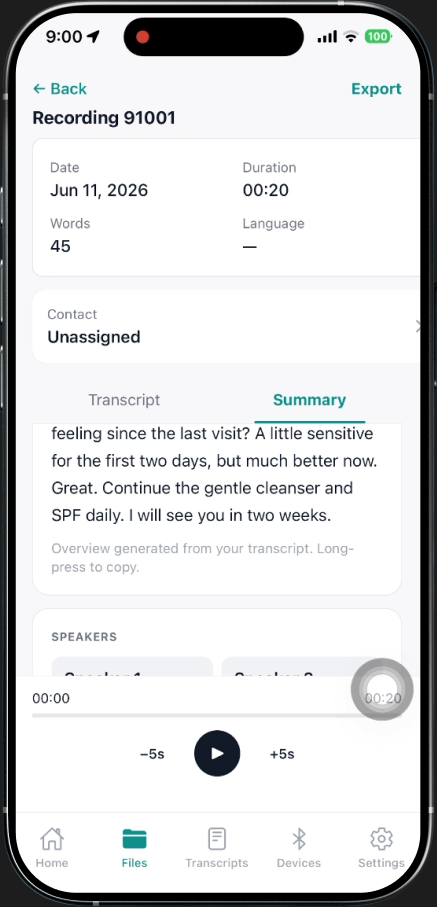
Using Plaud Embedded, PatientQ can now capture patient consultations via Plaud devices and run them through an AI engine that generates two outputs: EMR-ready medical SOAP notes, and consultation insight reports that score each staff member's sales performance across tone, listening quality, objection handling, and more.
The Problem
Ryan has spent years marketing on behalf of medical practices. His team qualifies leads, warms them up, and delivers them ready to convert. But something kept breaking down at the last step.
“These medspas were getting qualified leads before booking appointments. But a lot of times, the staff were not converting them.”
He'd run staff training sessions, walk the teams through proper sales processes, and every head in the room would nod along. Then he'd check back a month later. Same conversion rates.
The core issue was invisible accountability. When a consultation went sideways, there was no insight or visibility into what went wrong.
Ryan had a case in Las Vegas that crystallized the problem: he sent 15 qualified leads into a practice in one month, but the practice reported converting zero of them. When his team called those leads directly, a different story emerged. The problem wasn’t lead quality. It was how they were being treated at the door.
On the clinical side, the problem was equally costly. Doctors spending 15-30 minutes per appointment writing notes across four appointments a day - they were losing a full 1-2 hours of productivity to documentation that could be automated.
The Search
Integrating with laptop microphones
Ryan's first instinct was to solve this with software alone. If he could route audio from a computer or phone microphone into his AI pipeline, he wouldn't need hardware at all.
It didn't work.
“I tried funneling that into our own system based off the microphone on their computer or their phone. But I also found that it did a very poor job of actually picking up conversations that weren’t within three feet of it.”
A doctor treating a patient on one side of the room, with a laptop recording from the other side, was getting garbled audio at best and silence at worst. And the issue wasn’t fixable in software. “You can’t just magically improve the microphone capabilities with software from an outdated computer hardware side of things.”
Beyond audio quality, the workflow itself was a problem. Asking clinical staff to remember to hit record on a browser tab, or fumble with a laptop between appointments, was too much friction.
“If they have the NotePin S on their wrist while they’re doing the treatment, they can record in one click. That’s a much better experience for both the clinical staff and the patient.”
Why Plaud
Ryan had been a Plaud user personally for some time, using it to capture his own phone calls and auto-generate summaries to share with clients. He'd become a quiet evangelist.
He'd looked at alternatives, including online note-taker-like transcription apps and other hardware, but wasn't interested. That loyalty came from real-world use. Ryan had already validated the hardware on himself before betting his product on it.
“I had already tested yours and it has been reliable. The battery life is good, and it does what I always want it to do.”
There was also a brand factor. In the aesthetic medicine world, Plaud already had name recognition with the kind of early-adopter doctors and practice owners Ryan works with.
The embedded SDK and transcription API gave Ryan exactly what he needed: Plaud hardware capturing clean audio at real consultation distances and a speech-to-text pipeline optimized for real-world conversations.
The Outcome
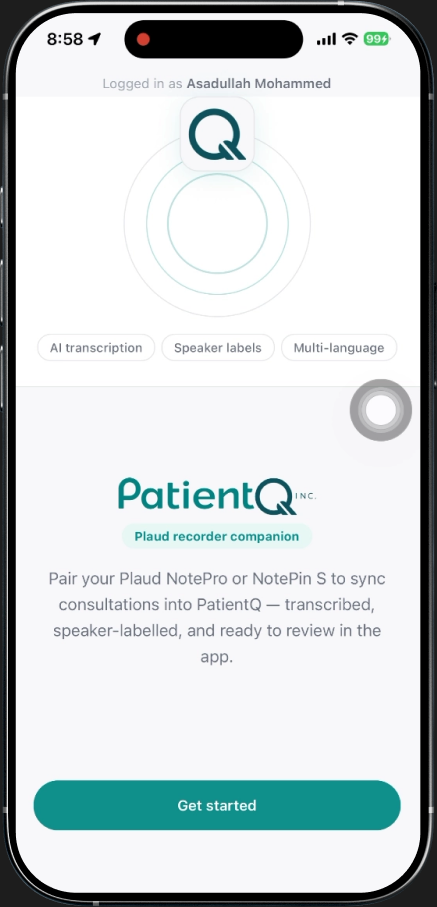
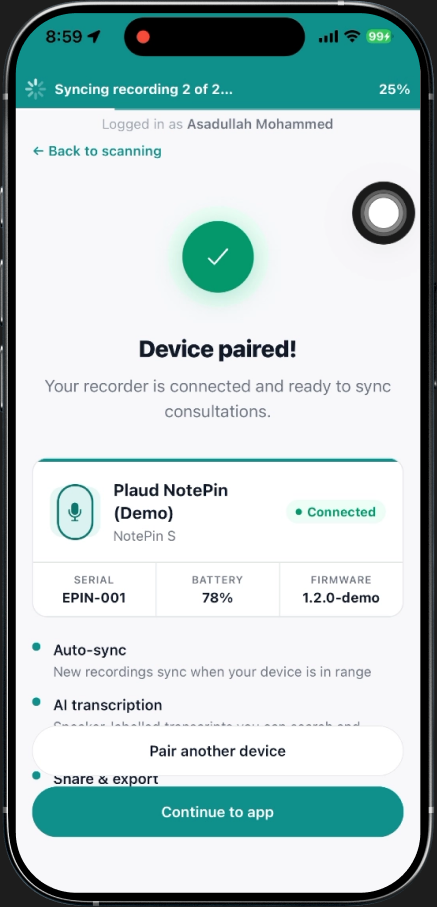
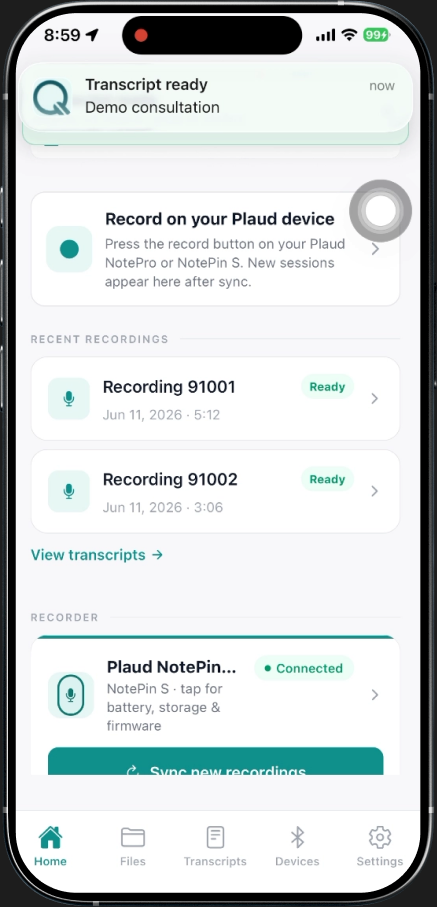
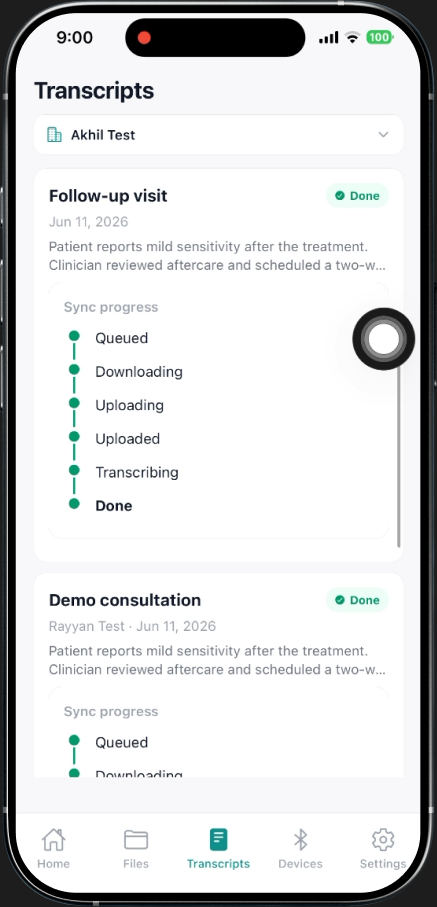
PatientQ shipped a mobile app in one week, using the iOS starter app, and has pilot clients using it already. The device captures the consultations, Plaud’s transcription pipeline turns it into speaker-labeled text, and PatientQ’s platform generates SOAP notes and consultation grades.
The results arrived faster than anyone expected.
The first practice that adopted had been running at a 65% internal conversion rate from consultations turning into booked treatments. In the three weeks after deploying Plaud, that number hit 95%.
“People perform extremely differently and put on their best sales presentation when they can be coached on their customer conversations.”
The conversation insight reports had done more than surface underperformance - they'd become a coaching tool. Rather than flying in a consultant to run sales training (and paying premium rates for advice that rarely sticks), practices could now run their own group training sessions using real recordings.
And the financial impact was concrete. In three weeks, with PatientQ's AI handling lead qualification and Plaud capturing consultations, the practice generated over $50,000 in revenue, attributable to a system that cost $1,500 to deploy.
“You can collectively do a group training process by taking these recordings, running them through as a group exercise, and figuring out what's the main points of weakness for your team.”
What's Next
Ryan is preparing to present at medical conferences, scaling PatientQ's client base, and heading toward a full app store launch with the new iOS app. As volume grows, so does the product vision.
The SOAP note and consultation grading outputs are a foundation for the system that will become what he calls “an almost autonomous patient acquisition system for medical practices.”
Product
PatientQ is building on Plaud Embedded, the transcription API and mobile SDK for developers who need real-world audio capture that works.